
Why a Video CV can be a gamechanger - and how IC Works can help
For a lot of people, the traditional written CV is treated as the ‘proper’ way to apply for a job. But from an accessible information perspective, it’s worth saying plainly: a standard CV can be a difficult task for everyone.
A written CV asks you to:
remember and organise your experience in the “right” order
choose the ‘right’ wording
keep it brief but not too brief
present yourself confidently while feeling judged
do all of this using a format that can be unforgiving if you struggle with writing, memory, anxiety, processing speed, or executive functioning.
If you’re supporting someone with a learning disability, autism, brain injury, dyslexia, ADHD, or other cognitive challenges, you’ll probably recognise the pattern,
CVs become a barrier before a job search has even properly begun
That’s why IC Works believes Video CVs are a great idea - not as a gimmick, and not as a replacement for every situation, but as a genuinely accessible option that can unlock opportunity,
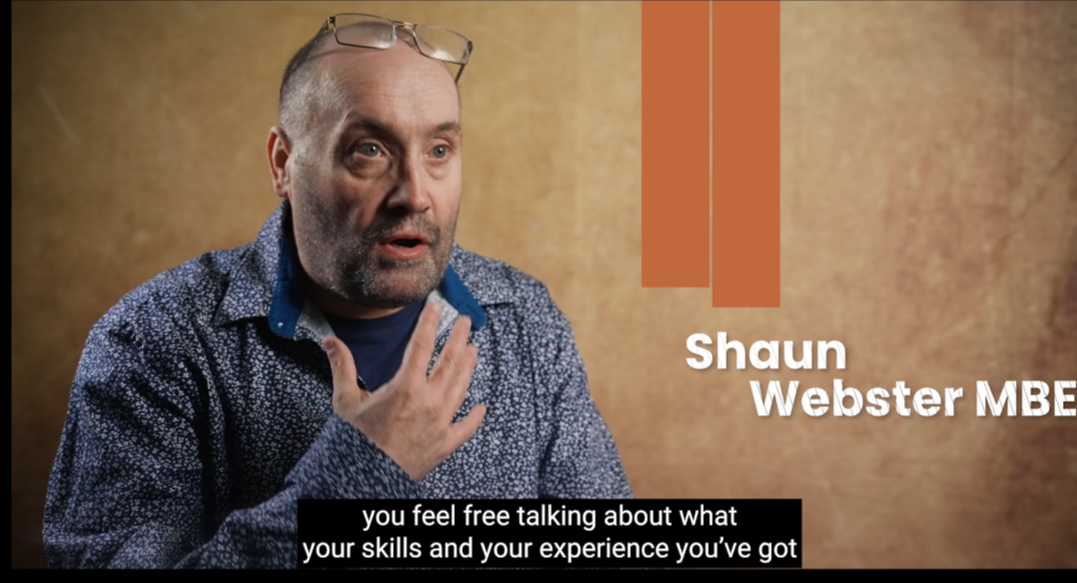
You can view two videos in this article that Shaun made with Speakup Rotherham for their Employment Is For Everyone website.
Shaun Webster MBE: Why Video CVs work (in real life)
Shaun Webster MBE is a member of Team IC Works’ panel of experts by experience. His advice on Video CVs is rooted in something very practical: for him, writing is not just difficult - it’s pressurising.
Shaun explains that having to write things down can create anxiety and make it much harder to explain what skills and experience you have.
But when he made a Video CV, he felt freer and more confident, and it supported him because he has short-term memory difficulties. He describes video as helping him remember key points about his work experience in a way that paper doesn’t.
There’s a bigger message underneath that: if the “proper CV” is the only route, people get filtered out before they even apply. Shaun makes the point that this can stop people from going for jobs at all, and employers then miss out on the skills those candidates bring.
From an inclusive employment perspective, that’s not a small issue. It’s a systems issue.
Accessible information isn’t “simplifying people” - it’s removing unnecessary barriers
At IC Works, we work with accessible information all the time. The goal isn’t to lower expectations or talk down to anyone. The goal is to remove format-based barriers, not ability-based ones.
A written CV can be a barrier because it:
relies heavily on reading/writing confidence
punishes short-term memory gaps (you forget something important, and it disappears)
demands a specific structure that isn’t natural for everyone
often triggers stress, which makes memory and language access worse.
Video can reduce that cognitive load because it allows people to:
speak more naturally (and show personality, warmth, motivation)
record in their own time (and redo parts)
use prompts without it ‘looking like prompts’
capture confidence that doesn’t always come through in text.
Shaun’s experience fits this exactly: he talks about creating a video CV at his own speed, taking his time, and using editing to get it right.
“But will employers accept it?”
Some will. Some won’t. And that’s why choice matters.
Shaun points out that employers should offer different options and describes a job with multiple routes (including an online interview and different steps).
This is a useful mindset shift
A video CV isn’t asking for special treatment.
A video CV is asking for reasonable access to the same opportunity.
A video CV is an alternative format that allows someone to demonstrate competence.
And when employers allow that, it increases the chance they’ll find excellent candidates they would otherwise never meet.
Shaun’s practical tips for a strong Video CV
Shaun’s advice is very grounded - and it’s exactly the kind of guidance that makes Video CVs work well:
Keep it short and focused
Shaun warns that if it’s too long or ‘long-winded’, people will switch off.
Use key points that match the job you want
Think relevance over completeness: your most relevant roles, skills, and strengths.
Don’t rush
Shaun specifically advises: don’t talk too fast, take your time.
Aim for just a couple of minutes
Enough to understand you, not so much that it becomes a life story.
We’d add one more from an accessible information lens:
Structure helps (without making it rigid) - a simple structure reduces cognitive load for the person making the video and the person watching it.
A good basic template:
Mame, plus what kind of job you want
Your top three strengths
One or two examples (work or life experience)
What support helps you do your best (if you want to share this)
A friendly close: “thanks for watching - I’d love to talk more.”
Where IC Works comes in
A Video CV can be empowering - but only if the person is supported in a way that feels respectful, calm, and genuinely enabling
IC Works can help someone with a learning disability to put a Video CV together by:
Helping them work out what to include (without overwhelm)
Reducing the cognitive load (simple prompts, structured steps, gentle pacing)
Supporting scripting in an accessible way (not “polished corporate”, but clear)
Helping with recording setup and multiple takes (no pressure)
Helping edit the final video so it’s short, clear, and job-ready
Optionally producing a matching written Easy Read summary for employers who prefer text,
And crucially: we do this in the spirit of co-production - with the person in control, supported by experts by experience like Shaun, and guided by what genuinely works in real life
A message to anyone supporting someone looking for work
If you know someone with a learning disability (or any cognitive challenge) who is looking for a job - and the CV feels like the barrier - this is your nudge:
Get in touch with IC Works
We can organise support to help them create a Video CV that reflects their strengths and increases their chances of getting seen.
Because the aim isn’t just “a nicer CV”. The aim is access to opportunity on fair terms, and a job market that stops filtering people out for reasons unrelated to what they can contribute.